
Greenville Previous Residents by Era
Greenville address history works best as an era ladder. The Hunt County Clerk’s historic General Index can establish an early filing trail, while the newer county land route, appraisal records, maps, directory holdings, newspapers, and city files each cover a narrower part of the story. Start with the date range you need rather than treating every source as continuous. A missing directory volume, an index-only result, or an absent online image is a documented access limit, not proof that no prior household existed.
| Record source | Greenville period | Custody or access | Useful address evidence |
|---|---|---|---|
| General Index to Deed Books | 1846–1916 | Hunt County’s Kofile index | Named parties, instrument trail, book/volume/page |
| Land-record route | Newer records | County-directed Tyler system or Clerk request | Later instrument identification and images where available |
| Directory and telephone leads | 1911–1916; 1932, 1947, 1949; 1960–2001 with gaps | Library, UT Briscoe, and Delta State holdings | Dated address or subscriber snapshots |
| Federal census | Released schedules under the 72-year rule | National Archives and library databases | Dated household and enumeration context |
| Sanborn maps and city files | Maps for 1885–1909; city retention not verified | Library of Congress, local history sources, city request route | Building footprint, street context, permit or notice trail |
For a recent transfer, begin with the parcel and current land route. For an older address, test the deed index first. If the aim is occupancy rather than ownership, move next to the dated directory, telephone, census, or newspaper material. Hunt County records should be read as separate strands that need corroboration.
Note: Record a source date and address label before comparing a Greenville filing with an older household reference.
Greenville Previous Residents Start With a Parcel
Freeze the present parcel before going backward. The Hunt Tax field model includes owner name, street number and name, property ID, geographic ID, tax year, map ID, legal description, subdivision, acreage, neighborhood, and mailing information. Use the parcel or geographic ID as the stable bridge between the current card, GIS geometry, and deed documents. The card’s owner display is not, by itself, evidence that the owner lived at the address.
- Parcel or geographic ID
- An identifier assigned to the property record. It helps distinguish a similarly named street or similarly numbered lot.
- Situs address
- The location assigned to the property itself. It should be kept separate from an owner’s mailing address.
- Legal description
- The lot, block, survey, acreage, or subdivision wording used in land records. It can survive a changed street label better than a postal address.
The research sample shows why this separation matters: a Hunt parcel can carry a Lone Oak situs and a Greenville mailing address. Do not merge those fields into one location. If a broad query times out, Hunt Tax advises simplifying to the street name or searching last and first names separately, then narrowing the result by parcel or geographic ID.
Greenville Previous Residents in the Deed Index
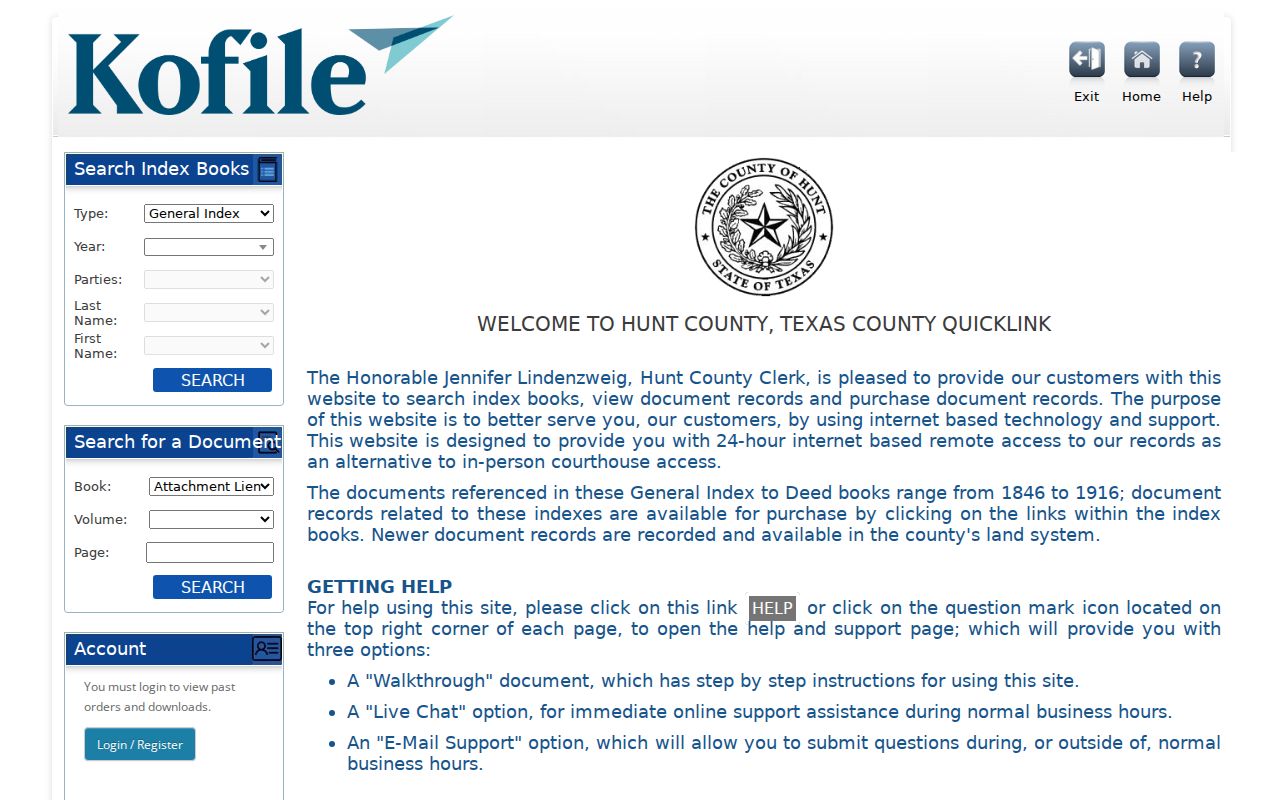
The Hunt County General Index to Deed Books exposes indexed documents from 1846 through 1916. Its controls support an index-book type, year, party, last name, and first name search, plus document lookup by book, volume, or page. That makes it a useful historical branch for previous residents research, but it remains an index. Save the exact party role and retrieval key, then obtain the underlying instrument when it is needed.
The Hunt County General Index capture shows its book, year, party, name, and document-reference approach.
A recorded result can anchor a parcel trail, yet it does not establish occupancy. Preserve both the filing date and execution date if the instrument shows them, because they can differ. The County Clerk identifies newer land records through its Tyler route, which begins with a disclaimer and did not expose post-acceptance fields in the inspected text interface.
The Hunt County Tyler land-record screen shows the current entry warning before the newer-record search route.
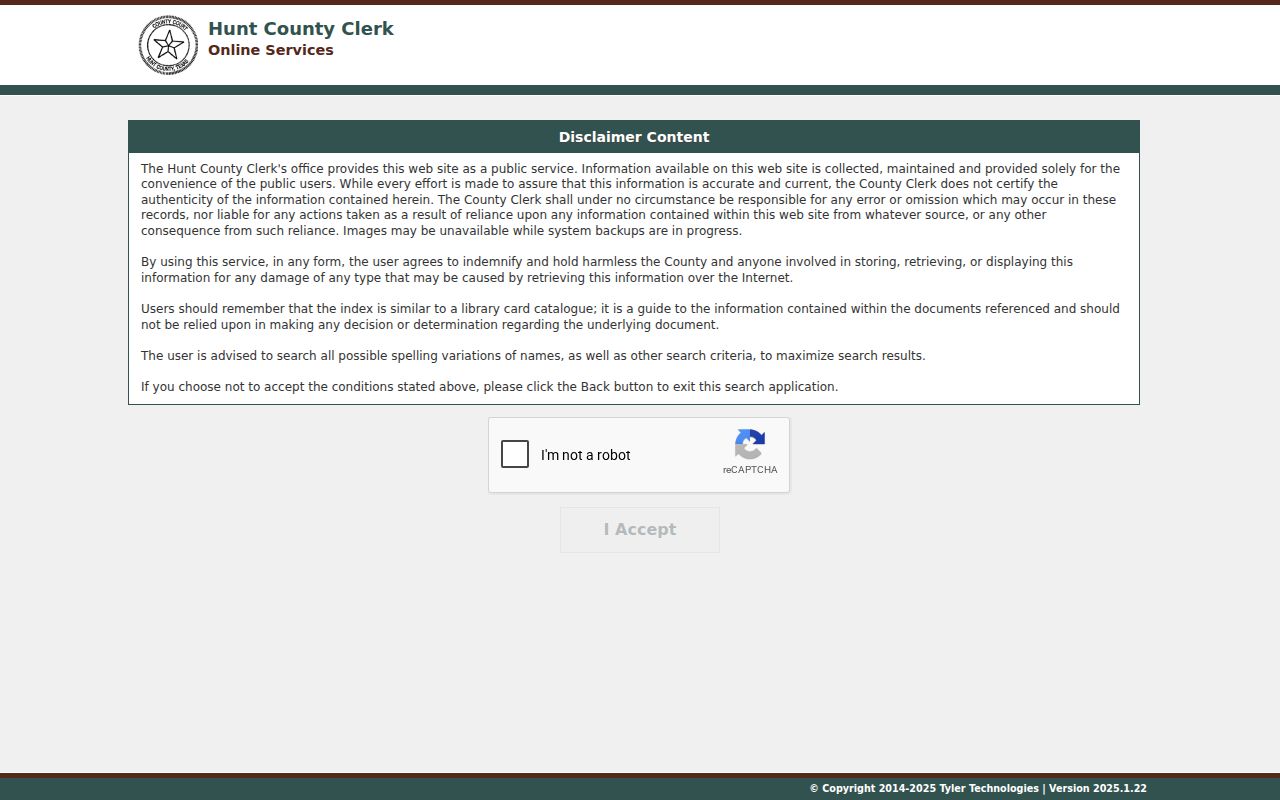
Treat the portal’s index and image warnings as part of the trail. Preserve the document reference, then request or inspect the specific instrument rather than making an address-history claim from the screen alone.
Follow Greenville Previous Residents Through Deeds
A chain of title is the sequence of recorded interests in a parcel. For past residents, it is the ownership half of the inquiry. Start with the current legal description and parcel ID, find the acquisition instrument, and then move from seller to earlier seller. Include releases, easements, deeds of trust, plats, corrections, and probate-related filings when they affect the same legal description. Each transfer needs its own document and date.
- Open the current CAD or tax record and copy the parcel or geographic ID, situs label, map ID, and full legal description.
- Use the current owner and legal description to identify the latest recorded purchase in the county land route.
- Read the seller on that instrument as a potential earlier grantee, then locate that person’s earlier purchase by the same legal description.
- Repeat the sequence backward, comparing lot, block, abstract, acreage, subdivision, and parcel geometry after each correction or replat.
- When the history reaches 1916, use the Kofile General Index and its book, volume, or page reference to retrieve the earlier filing.
- Grantor
- The party conveying an interest in the recorded instrument.
- Grantee
- The party receiving that recorded interest. A grantee is not automatically an occupant.
- Chain of title
- A documented sequence of transfers for the same parcel, not a shortcut for identity or residency.
The Clerk is a recorder, not a title examiner. Its property-copy request form expects the requestor to identify a document number or enough detail. Plain copies cost $1 per page; certified copies add $5 per document. Mail requests need the form, payment, and a self-addressed stamped envelope, while the Clerk also lists email and in-person routes.
Greenville Address Footprints on Sanborn Maps
Maps help date a place, not a resident. The Greenville 1888 Sanborn collection has five sheets, and related Greenville runs include 1885, 1893, 1898, 1903, and 1909. These fire-insurance sheets can show street names, lot lines, building footprints, story count, outbuildings, use labels, and nearby landmarks. Pair a map observation with a deed, directory, or newspaper before making a household connection.
A changed footprint can suggest rebuilding after Greenville’s documented fires or later development. It cannot identify who lived inside. No official Greenville street-renumbering or renaming project was verified, so an apparent address change needs proof from ordinances, plats, USPS history, permit files, or successive dated entries.
Note: Treat a former street label as a research question until a dated map, plat, or directory connects it to the parcel.
Greenville Past Residents Beyond Ownership
Owners are only part of the household trail. The Texas State Library explains that city directories can contain names, addresses, phone numbers, spouse labels, occupations, and ownership notation, with alphabetical, address, or telephone arrangements. Greenville leads are not one unbroken run: the directory guide lists 1911, 1913, and 1916, UT Briscoe records Greenville Telephone Co. volumes for 1932, 1947, and 1949, and Delta State lists particular volumes from 1960 through 2001 with gaps.
- Choose a dated directory or telephone volume close to the transfer or building period.
- Transcribe the volume year, publisher, page, directory type, address, initials, and any editorial notation exactly as printed.
- Compare an adjacent available volume before treating a household as continuous at the Greenville address.
- Pair the dated entry with the released federal census that fits the same period and correct enumeration geography.
- Use a newspaper notice, permit record, or deed only as a second dated source, and label the connection as evidence rather than certainty.
The historical holdings themselves belong to the Greenville city directories collection. No Greenville-specific complete reverse or criss-cross run was verified, so address sections and the deed/GIS sequence are safer than assuming one exists. Federal census schedules are dated household snapshots; they do not solve every same-name problem or confirm a present address.
Greenville Previous Residents and Local History
No dedicated Greenville or Hunt County house-history service was found in the official sources. The practical substitute is a sequence: CAD parcel card, GIS geometry, deed image, Sanborn sheet, directory or telephone volume, newspaper, then city permit or code file. The Northeast Texas History and Genealogy Center holds historic photographs, maps, rare books, family manuscripts, and local news material. Its collection description identifies Greenville publications from 1894 to current and Greenville Morning Herald links from 1890 to 1956.
The Center’s access matters. It lists library-only subscriptions including Ancestry Library Edition, FamilySearch, and a newspaper service with Greenville Herald-Banner coverage; America’s News can be reached from home with a library card according to the page, while some services require the W. Walworth Harrison Public Library selection and a password. Keep the newspaper title, issue date, page, headline, and archive URL with each note.
Greenville Previous Residents Across Record Gaps
Greenville’s courthouse history explains why a clean sequence can break. Hunt County formed in 1846, and the county’s historic deed index begins in that early period. The Historical Commission’s Seven Courthouses marker describes early courthouse sites, the 1883 courthouse and business-district fire sequence, an 1885 replacement, and the present courthouse dedication in 1929. Those events are reasons to check the custodian and record type carefully, not evidence that a particular book was lost.
The sources reviewed do not provide an authoritative list of specific Hunt County record books destroyed in the fires. The right response to a missing result is a County Clerk or archive inquiry and a written gap in the timeline. The Hunt County records inventory at the Portal to Texas History can help plan an archive visit, but it does not replace the present custodian.
Note: A gap between Greenville volumes or land indexes is evidence of access limits, not proof that a household disappeared.
Greenville Previous Residents at Trail Endpoints
Newspapers, obituaries, cemeteries, and probate can help close an address trail, but each needs careful scope. Search a street, business, court cause number, marriage or obituary notice, civic group, school, church, and event date. A notice may use initials, a relation, or a former street name. Preserve the source details and verify a claimed family connection against a second dated record.
The Hunt County Historical Commission offers markers, cemetery information, photographs, a timeline, and family-land history. Its cemetery page is a location and history resource, not a verified online interment index for every burial. Restricted vital records remain subject to Texas access rules, so a certificate should be requested only through the proper qualified-applicant route when the public period has not begun.
Greenville Previous Residents Evidence Sequence
Keep the result as a sequence of records, not a roster. The strongest order is: parcel ID and legal description, current GIS geometry, recorded instrument, dated map, dated directory or telephone source, census or newspaper confirmation, and city record when available. A deed holder may not have lived on the parcel, a directory subscriber may not have owned it, and a map shows a structure rather than a household.
Use the County Clerk’s records-request route when a portal or image is unavailable. The Clerk reports free in-office inspection Monday through Friday, 8 to 4:30, and says its responses should identify availability and cost within ten business days. For city permit or code context, the public result fields were not verified, so request an existing record through Greenville’s written public-information route. A narrow request with a record type, date range, legal description, and document identifier is more likely to locate an existing record than a request asking an office to reconstruct an address history.