
Greenville City Directory Holdings
The local directory evidence comes from several shelves and catalogs. The Texas State Library guide identifies leads for 1911, 1913, and 1916, while warning that 1912, 1914, and 1915 are absent from that guide. UT Briscoe catalogs Greenville Telephone Co. volumes dated March 1932, May 1947, and June 1949. Delta State Archives lists a much later run with visible gaps. The result is a useful sequence, but it is not proof of continuous publication or complete survival.
| Collection trail | Documented years | Where held | Access route |
|---|---|---|---|
| Texas directory leads | 1911, 1913, 1916 | Library and archive catalogs or databases | Confirm a scan or volume through the catalog |
| Greenville Telephone Co. metadata | 1932, 1947, 1949 | UT Briscoe Center | Catalog and reading-room route |
| Greenville City Directories | 1960, 1961, 1962, 1964–1966, 1968–1971, 1973–1975, 1981, 1985, 1987, 1989–1994, 2000–2001 | Delta State Archives, Cleveland, Mississippi | Ask the archive about access and reproduction |
| Greenville Morning Herald trail | 1890–1956 | Northeast Texas History and Genealogy Center | Collection and subscription access vary |
The Texas State Library directory guide notes that a city may have a directory in one year, a telephone book in the next, and no surviving volume for another year. Record the cited year and format before drawing any conclusion from a gap.
Greenville Directory Years in Context
The known Greenville directory trail changes type as well as date. The early leads are city directories. The Briscoe records are telephone-directory metadata. The Delta State finding aid names held city-directory volumes, but not every year between the first and last listed volume. That distinction matters when comparing a printed address, a telephone listing, and a newspaper notice. Each is a different kind of dated evidence.
- 1911, 1913, 1916: Treat the Gale and Texas State Library guide as a lead to an actual library or database item, not proof that no other copy exists.
- 1932, 1947, 1949: Use the UT record to identify the Greenville Telephone Co. volume by date, then seek the page image or reading-room access.
- 1960–2001: Use the Delta State finding aid’s listed years as the archive request starting point and preserve the edition year and page.
Note: A directory series has gaps in both publication and preservation, so absence from one catalog is not proof that a household was absent.
Greenville Directory Research Desk
The Northeast Texas History and Genealogy Center is Greenville’s main local bridge when a directory lead needs maps, newspapers, photographs, or family manuscripts. It is at 1 Lou Finney Blvd. and lists hours on Monday 3–8, Tuesday 2–6, Wednesday 10–2, Thursday 4–8, Friday 1–5, and the first Saturday 10–6. The center is otherwise closed on weekends. Its phone is 903-457-2992.
The center reports more than 127,000 physical and digital items, material for more than 212 Texas counties, and about 300 family histories and manuscripts. Its local newspapers run from 1894 to current, and it identifies Greenville Morning Herald links from 1890–1956. Ancestry Library Edition, FamilySearch, and some newspaper access are library-only. America’s News may be available from home with a library card, while other services require choosing W. Walworth Harrison Public Library and entering a library password.
See the History and Genealogy Center’s collection page before arranging a visit.
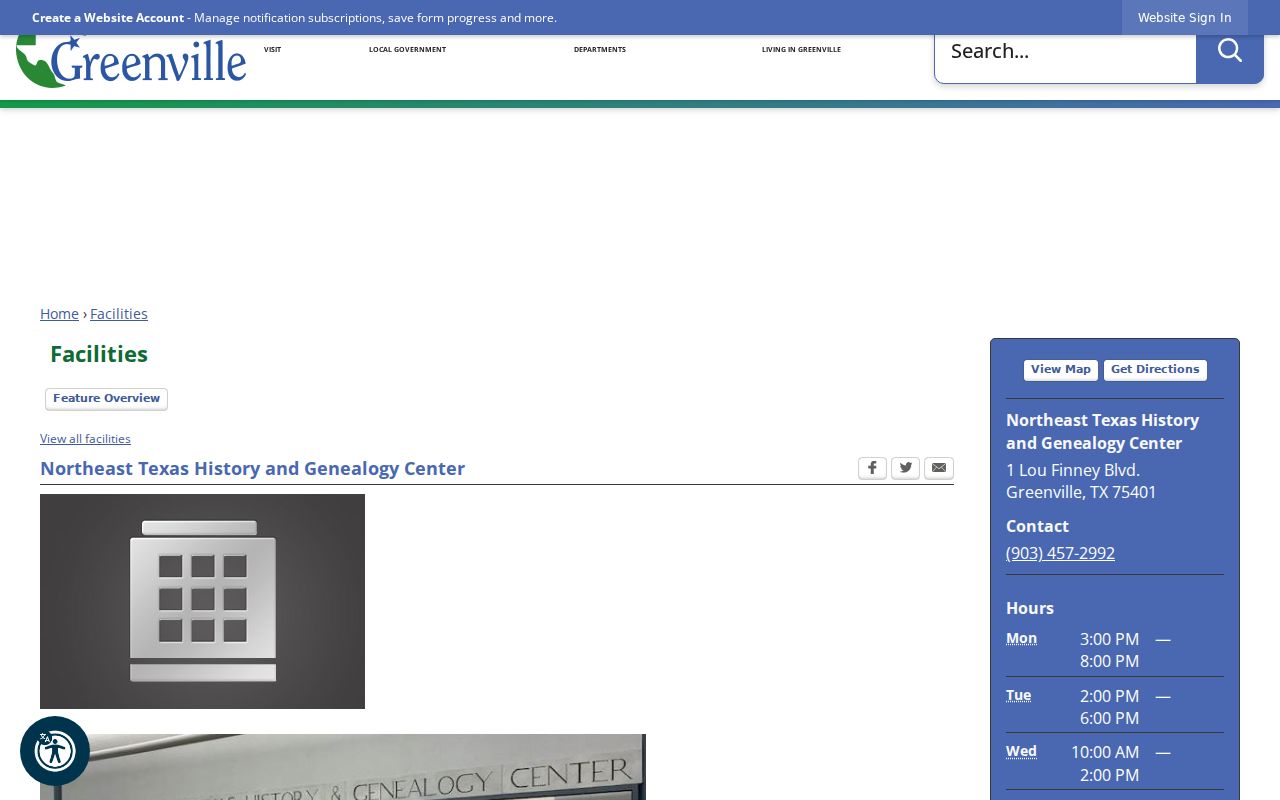
The local center adds a newspaper, map, and manuscript route when a catalog record alone cannot establish a move, name variation, or street transition.
Reading a Greenville City Directory Entry
A Greenville city directory entry is a publication snapshot. The Texas State Library guide says entries may include a name, address, phone, spouse, occupation, and an owner-status field. Arrangement can be alphabetical, by address, or by telephone. Exact wording is valuable. Initials, suffixes, parenthetical spouse labels, and abbreviated lines can separate similarly named people without supplying more than the volume itself supports.
| Name form | Copy initials, suffixes, spelling, and any cross-reference exactly as printed. |
|---|---|
| Address or route | Distinguish a street address from an office, post-office box, or rural route. |
| Telephone line | Note whether the volume is a telephone directory and retain its date and publisher. |
| Spouse label | Preserve any parenthetical spouse wording as a printed clue, not a conclusion about identity. |
| Occupation or owner-status line | Transcribe the line as printed, with no present-day inference. |
| Citation details | Keep the volume year, publisher, page, directory type, and source location. |
- Address section
- A part of a volume arranged by street or address when that edition includes one.
- Householder index
- An index organized around the named household entry rather than a complete statement of everyone at an address.
- Abbreviation key
- The volume’s explanation of shortened printed terms. Photograph or transcribe it with the entry.
Greenville Directory Catalog Routes
The UT Briscoe Center directories index offers Location, Directory Type, and optional Year Range fields. Its Greenville telephone-directory result gives the dates, but metadata is not the same thing as a page containing a person’s entry. Use the catalog to identify the item and its format, then ask about the reading-room or reproduction path.
The Delta State McCormick Collection finding aid supplies the later Greenville run and its gaps. It does not promise an open-ended name search. Contact the archive about access and reproduction instead of assuming a remote lookup is available.
The UT directory index shows the kind of location, type, and year controls that help narrow a catalog search.
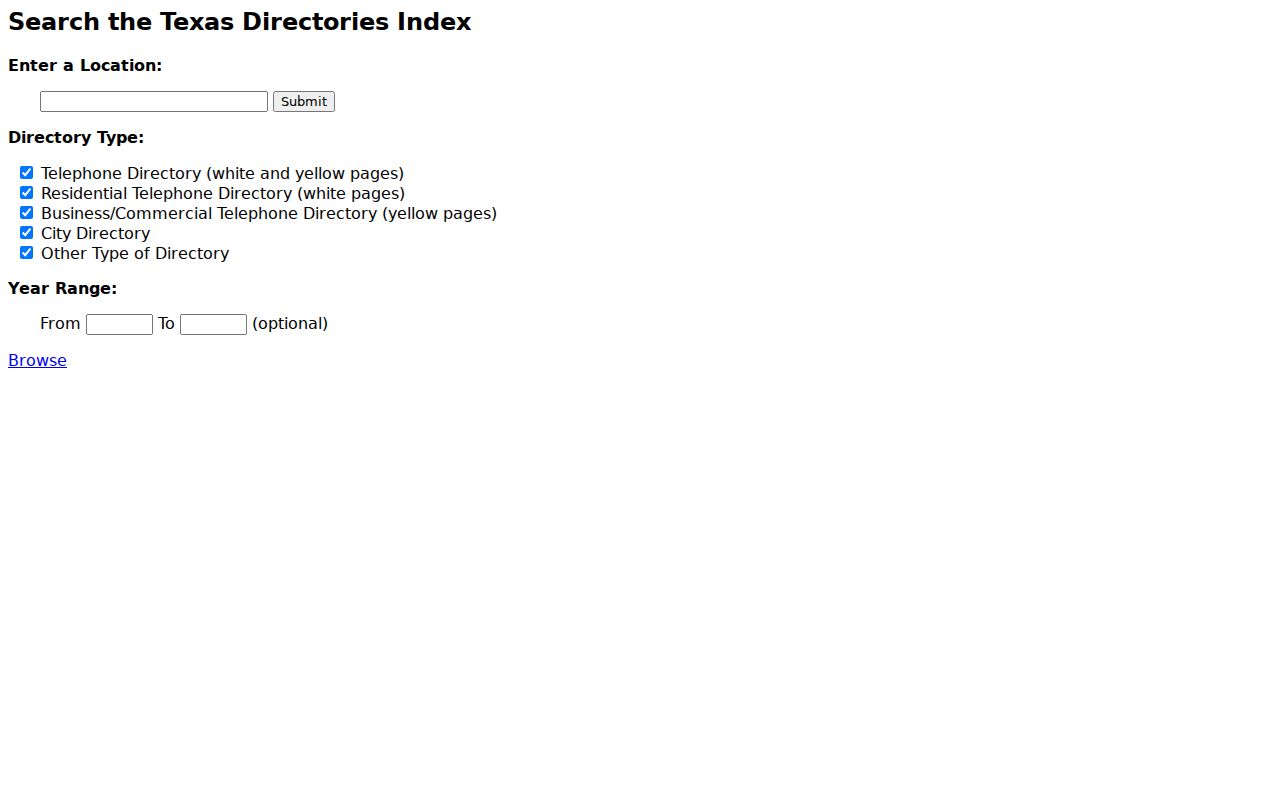
Use the catalog filters to locate an edition, then record the holding institution and the access condition with the citation.
Greenville Directory Address Sections
Some historical volumes use address or telephone arrangements that can help test a street connection for one dated edition. Start with a known street and year, then compare the alphabetical section, the telephone section, and advertisements where available. A printed residence, office, post-office box, and rural route are not interchangeable, so retain the exact label.
No Greenville-specific reverse or criss-cross directory run was verified in the official catalogs reviewed for this research. Do not assume one exists. Address sections of the listed volumes, telephone books, the Hunt CAD and GIS workflow, and recorded instruments are the supported routes for an address question. For a current parcel chain, use the Greenville by-street directory rather than treating an old listing as current.
Greenville Directory Newspaper Bridges
Newspapers can help test a transition between two editions. The History and Genealogy Center identifies Greenville Morning Herald links for 1890–1956, Greenville news publications from 1894 to current, and Herald-Banner coverage through a licensed newspaper database. A notice may use initials, a former street name, a business name, or a family relationship instead of a full modern address.
Search the event date as well as the street or name. Keep the newspaper title, issue date, page, headline or notice, and database or archive URL. A dated clipping can support a question raised by a directory entry, but it still needs a second source before a family connection is treated as settled.
Note: A newspaper notice can confirm a dated event or address reference, but it does not turn an incomplete directory series into a continuous roll.
Trace Greenville City Directories by Year
Family history research is strongest when each volume is kept in sequence. Begin with the first confirmed appearance, copy the entry and its citation, then move to an adjacent available edition. A change in spelling, spouse notation, route, or address is a lead for more research. It is not enough by itself to prove a move, death, or relationship.
- Choose a documented Greenville volume and search the name, street, or telephone arrangement that its format supports.
- Record the exact entry, edition year, publisher, page, and whether the location is a residence, office, box, or route.
- Check the closest available preceding and following editions, keeping missing years visible in the notes.
- Pair the dated listings with the relevant census period, a deed, a newspaper notice, an obituary, or a library manuscript.
- When a historical identity needs a modern record check, use a dated official source through the Greenville resident lookup.
A missing entry can reflect irregular publication, an unlisted telephone, an indexing difference, a non-digitized volume, or a different source type. The sound practice is to name the gap and try the next supported custodian.
Greenville Records Survived Change
Greenville’s record landscape has changed with the county seat. The Texas Historical Commission’s Seven Courthouses marker describes early sessions under oaks near St. John and Bourland streets, later courthouse buildings, the 1883 and 1884 fire sequence, an 1885 replacement, and the present courthouse dedication on April 11, 1929. Those events make it important to identify the actual volume and custodian rather than presume a single continuous local collection.
The Hunt County Historical Commission adds marker, cemetery, photograph, timeline, and family-land context. The reviewed sources do not provide a complete authoritative inventory of record books lost in the fires. A missing item should prompt an archive or custodian inquiry, not a reconstructed claim.
The Historical Commission’s research paths place a directory entry beside wider Greenville history without converting historic context into a resident list.

Markers and collection pages can supply a source date and place context for a directory citation, but each person connection still needs dated evidence.
Greenville City Directory Access Limits
Access differs by keeper. Texas State Library print and microform city directories are available in the Austin Reference Reading Room, and staff do not search or transcribe them by phone or email. The guide points to the Portal to Texas History, the Briscoe Center, subscription U.S. City Directories, HeritageQuest through TexShare, WorldCat, and the Library of Congress. Subscription or library-only access belongs in the citation.
Use the local center for its in-person collection and licensed databases, the Briscoe and Delta State catalogs to identify held items, and the relevant archive for a reproduction request. Never infer a person’s present residence from an historical listing. Historical research should remain personal, lawful, and respectful of protected information and other people’s privacy.