
Finding Greenville Resident Records
A Greenville residents directory is strongest when the search begins with a dated fact: a name, an address, a parcel number, a court number, or a directory year. Hunt County keeps several separate systems, each with a narrow purpose. An appraisal card can show an owner display and tax mailing address. A deed index can show parties to a filing. A library volume can place a household at an address in one year. None alone proves a current home, identity, or relationship.
Start with the record that matches the question. An address usually points first to the property roll. A family-history question may begin with a printed directory or newspaper. A court question needs a case number and the right court. Keep the record date and access date together, because a changed portal result or precinct does not rewrite an older record.
- Search the Hunt Tax property tool by a simple street name, parcel identifier, or owner name when appropriate.
- Keep situs, mailing address, geographic ID, legal description, and tax year as separate facts.
- Use the Texas voter portal only for fields it lawfully displays, then date the result.
- Follow a documented land party through the Hunt deed index or the newer Tyler route.
- For a missing record, ask the custodian for a specific existing document, date range, or identifier.
Greenville Offices Behind Resident Rolls
Greenville is the Hunt County seat, which puts the core county custodians close together. The County Clerk records land instruments and maintains county and court-related functions. Hunt CAD supplies appraisal and parcel context, while the Elections office handles registration maintenance and voter-file requests. The City of Greenville has its own request route for municipal records. A result belongs to the office that made it, not to a general directory.
Hunt County Appraisal District
Parcel and appraisal records
Hunt County, Texas
Use the CAD directory
Hunt County Elections
2217A Washington St.
Greenville, TX 75401
(903) 454-5467
Note: The Clerk offers free in-office inspection Monday through Friday, 8 to 4:30, even when an online route is disrupted.
Greenville Parcel Names and Addresses
The Hunt Tax property search connects an address search to the appraisal record. Its field model includes owner name, street number and street name, property ID, geographic ID, property type, subdivision or condo, abstract, legal description, owner ID, tax year, neighborhood, and doing-business-as. Broad searches can time out. Hunt Tax specifically suggests simplifying an address to the street name, or trying last and first name separately, then narrowing the result with a parcel or geographic ID.
| Hunt Tax field | How it helps | Important limit |
|---|---|---|
| Owner name | Finds a displayed appraisal owner | Names can change with system updates |
| Street number and name | Finds a property by site address | Use a simplified form if a query is too broad |
| Property or geographic ID | Anchors a parcel across search steps | Keep the tax year with the identifier |
| Legal description | Bridges CAD to deeds and plats | Verify acreage and wording with CAD |
A parcel is the tax or map unit for land. The situs is the property location used on the appraisal record. A tax mailing address is where correspondence goes and may be elsewhere. Those labels cannot be merged into one claim about who lives in Greenville.
Greenville Geography Changes a Search
City limits, the extraterritorial jurisdiction, a ZIP code, a voter precinct, a CAD neighborhood, and a parcel boundary are different layers. A Greenville mailing address can belong to a parcel outside the city limits. The City of Greenville map collection provides city-limit, ETJ, street, zoning, voting, subdivision, and service maps. It should be read beside the CAD record and a USPS result, not as proof of title or delivery.
The city map displays 75401 and 75402. USPS also has Greenville postal designations 75403 and 75404, which need address-level verification and may represent a secondary or PO-box context. An official result should retain its source label: USPS address, CAD situs, owner mailing address, or legal description. That small discipline prevents a common but serious matching error.
Greenville Voter Records With Limits
Texas My Voter Portal is a current official lookup, not a broad biography. Texas guidance allows limited public voter information, including name, date of birth, VUID, and elections voted, to the statutory extent. It does not reveal a ballot choice. Social Security, driver-license and DPS identification data are confidential, and protected residence information can be suppressed or replaced.
Hunt County also accepts a defined voter-file request. Its form offers delivery and format choices and lists paper at $0.10 per page or a CD at $50. Texas Election Code §18.009 restricts commercial promotion use of voter-registration information. A named, narrow request that identifies a record need is more useful than an attempt to assemble a person list.
The captured voter portal view shows the current official entry point for a Greenville residents directory search.
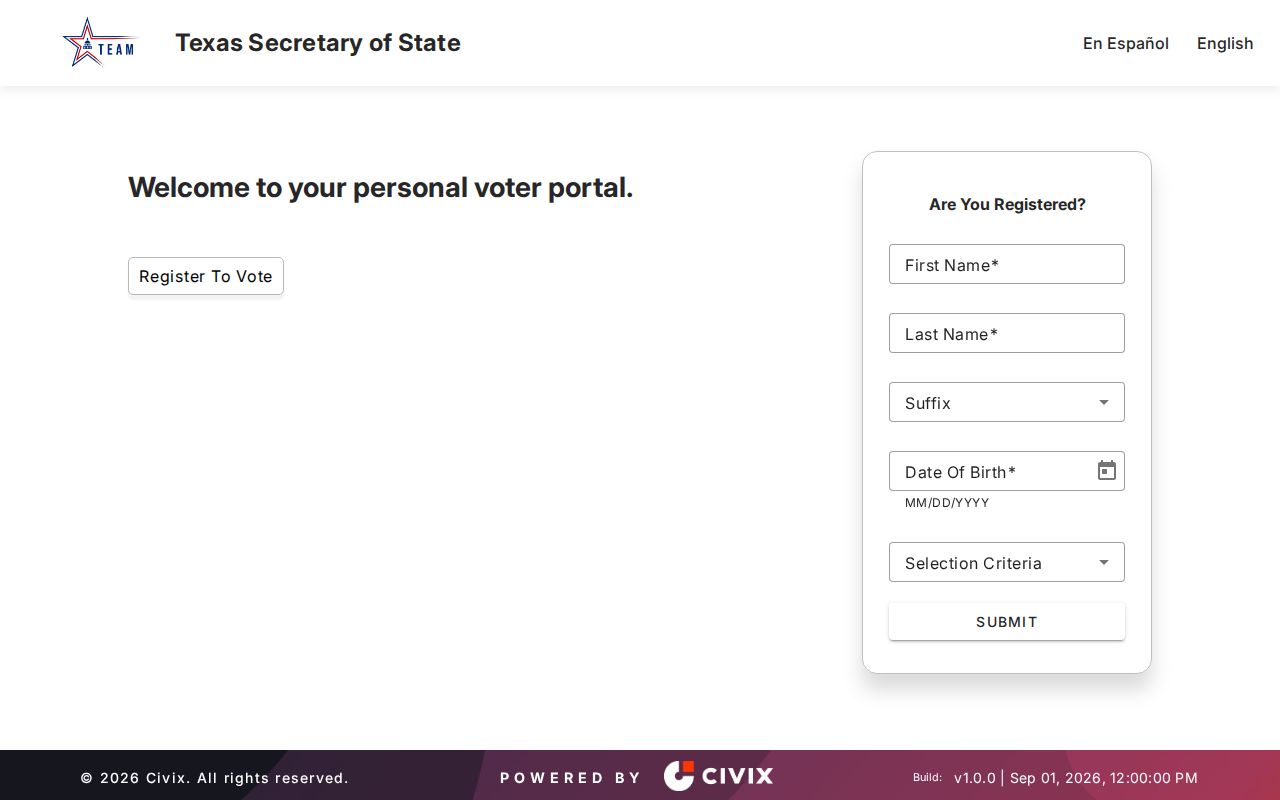
Use the portal result as a dated lead, then confirm any historical connection with an independent record.
Greenville Deed Parties Through 1916
The Hunt County General Index exposes indexed deed books from 1846 through 1916. It can be searched by index-book type, year, party, or name, and by book, volume, or page. A grantor conveys an interest; a grantee receives one. An index row is only a lead. Preserve the exact hit, distinguish the filing date from an execution date, and retrieve the underlying instrument where possible.
Newer Hunt County land records route through Tyler. The County Clerk says its staff does not conduct property searches, so a copy request should identify a document number or enough detail to locate the document. Plain copies are $1 per page and certified copies add $5 per document. Mail requests require the completed form, payment, and a self-addressed stamped envelope.
The General Index interface preserves the controls needed to search the historic Greenville deed trail.
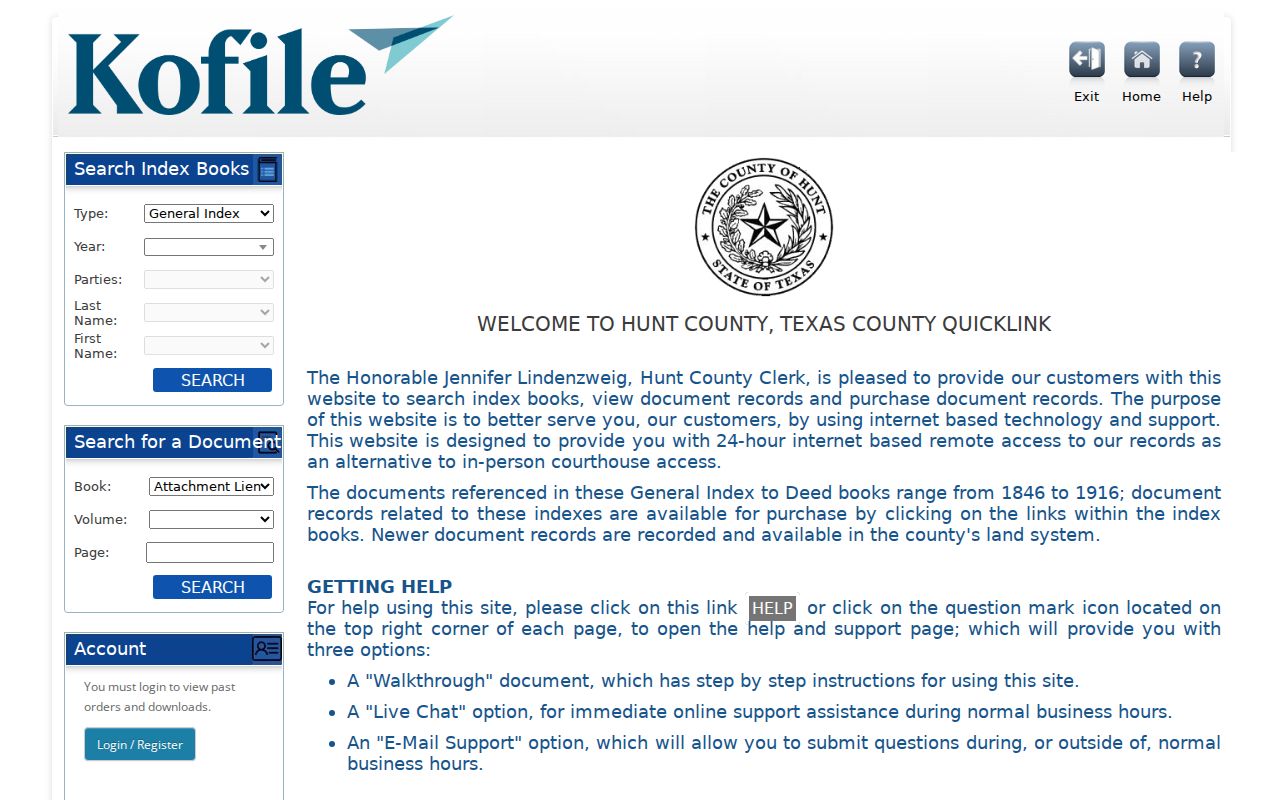
A deed party may be an owner, lender, heir, or other filer. It is not automatic evidence of occupancy.
Current Greenville Directory Sources
Current Greenville resident directories are best treated as separate, purpose-built sources. The property roll addresses parcel administration. The voter system follows election law. Recorded instruments name document parties. City staff contacts identify municipal custodians, while licensed and archival sources may have narrower access. Each source answers a different question and has its own privacy boundary.
| Greenville source | What it can show | Custodian | Access path |
|---|---|---|---|
| Hunt CAD and tax search | Parcel, owner display, situs and mailing fields | Hunt CAD / tax system | Online search and CAD verification |
| Texas voter lookup | Limited statutory voter fields | Texas SOS / Hunt Elections | Portal or defined county request |
| Land index | Recorded party and instrument lead | Hunt County Clerk | Kofile, Tyler, counter, or copy request |
| City records | Existing municipal records by subject | City Secretary or department | Written public-information request |
For one name that needs a careful cross-check, use the Greenville resident lookup workflow rather than blending records that only share a surname.
Greenville Court Routes by Record
Hunt County’s docket search takes a court and date, accepts MM/DD/YYYY or YYYY-MM-DD, and returns the next 30 days when the date is blank. It is a calendar view, not a complete party index. The Clerk directs criminal misdemeanor, civil, and probate searches to iDocket, while re:SearchTX can provide statewide court access where a county participates. Coverage and documents vary.
Keep the cause number, case style, court, parties as displayed, filed date, event date, status, and access date. Sealed, juvenile, expunged, and other confidential matters may be absent. Judicial records follow Texas Rule of Judicial Administration 12 rather than the ordinary public-information process, so the actual-file fallback is a specific clerk request.
The re:SearchTX public entry screen illustrates the statewide access route that may supplement a Greenville court search.
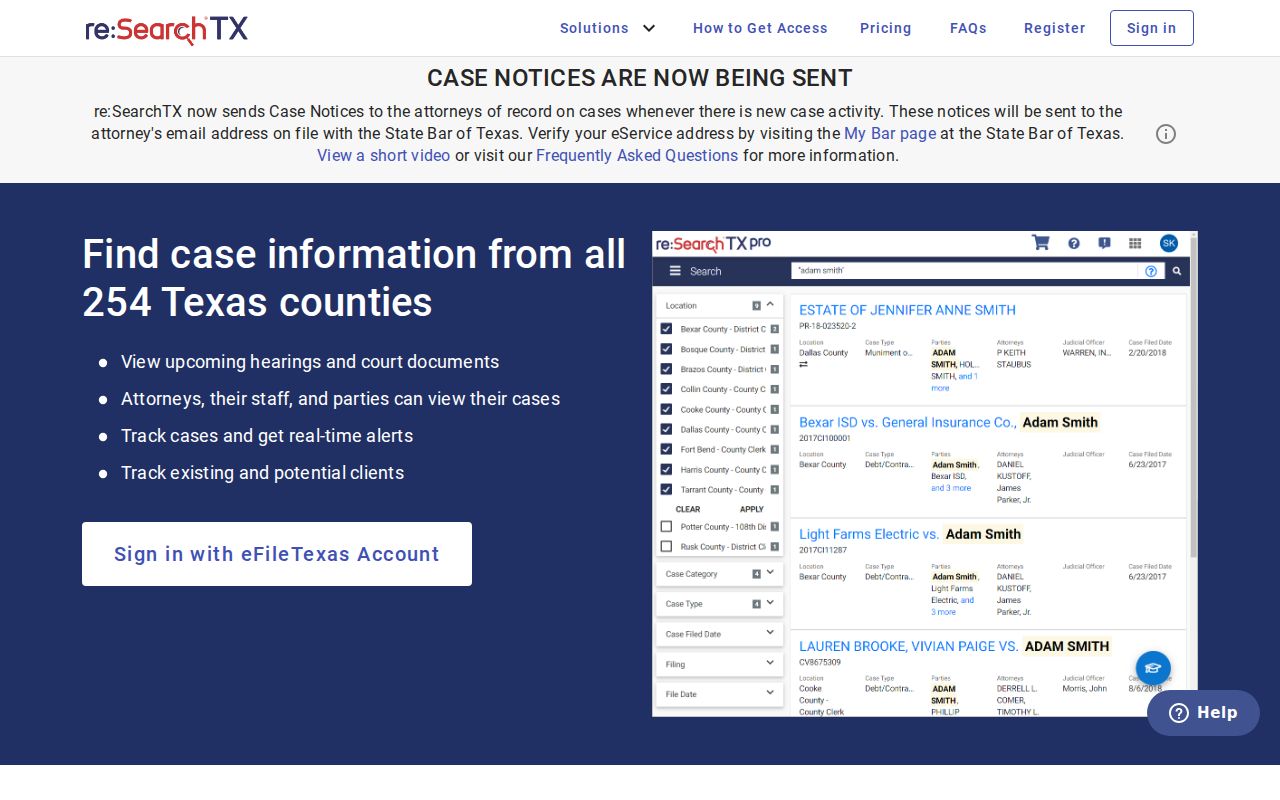
Confirm Hunt County availability and public document access before relying on a portal result.
Greenville Historical Directory Shelves
For dated household research, Greenville has a useful but uneven paper trail. UT Briscoe metadata identifies Greenville Telephone Co. entries for March 1932, May 1947, and June 1949. The directory guide also points to 1911, 1913, and 1916 leads. Delta State lists Greenville city-directory volumes from 1960 through 2001, with gaps. That is a set of collections, not one continuous publication.
The Northeast Texas History and Genealogy Center supplies Greenville newspapers, maps, photographs, rare books, and family manuscripts. Use a volume year and page with every directory finding. The fuller collection and entry-reading method belongs with the Greenville city directories.
Greenville Requests Need Real Limits
The Texas Public Information Act, Texas Government Code Chapter 552, gives a route to existing government records but does not require an agency to create a new list or answer a vague question. The City of Greenville request page asks for enough detail to locate an existing record. It also reports that Resolution 26-128, adopted August 25, 2026, sets significant-staff-time guidance under §552.275.
Name the department, record type, date range, street, case number, or document number. The City Secretary coordinates city requests, while police records go directly to the Police Records Division. County records go to the appropriate county custodian. An access outage does not prove that a record vanished, so save the page date and ask for an alternate inspection or copy route.
Greenville's public-information request page shows the written-request requirements and current staff-time notice.
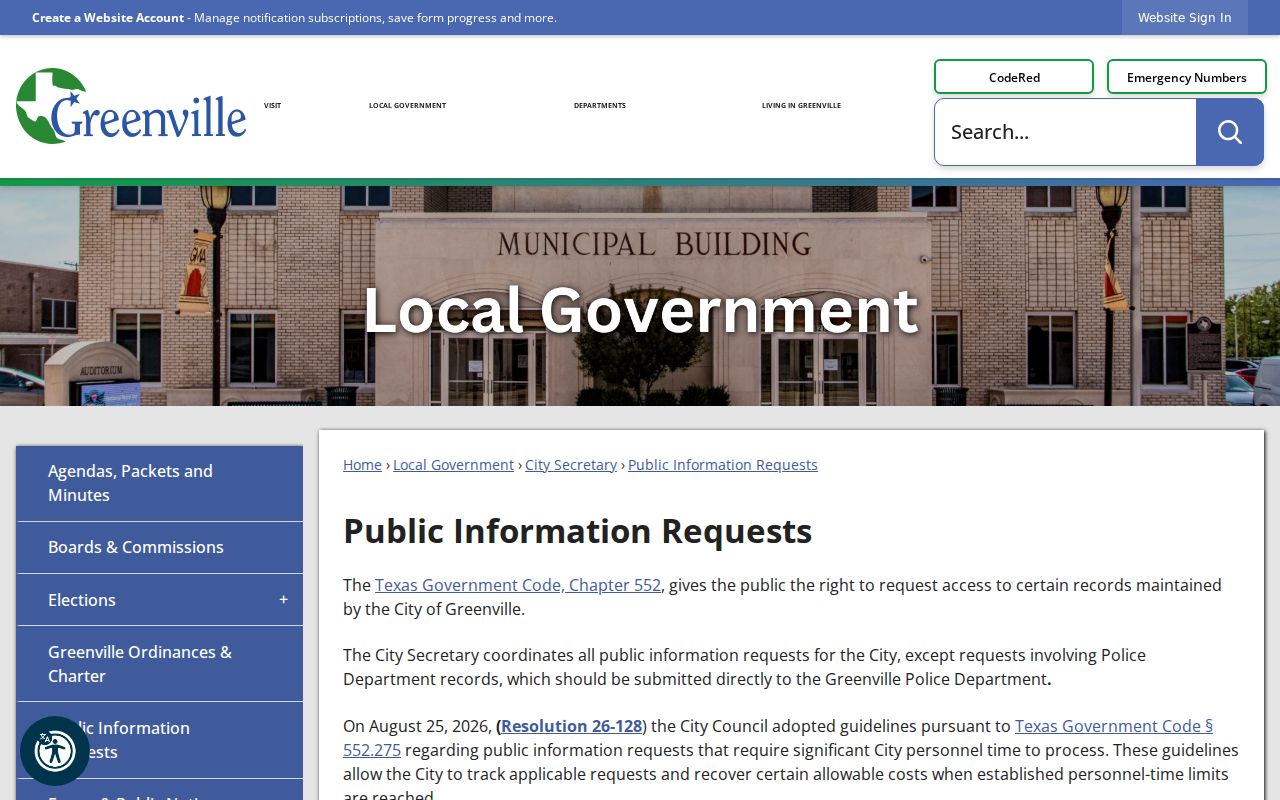
A precise request helps the custodian locate a known record without turning an index search into a request for a new report.
Greenville Results Need Two Sources
Same-name records are common. Compare middle initials, suffixes, a street or ZIP, a year, a cause number, and the source’s own date. A spouse or household label is not always the subject of the record. When records disagree, retain the contradiction instead of selecting the most convenient match. A second dated source, such as a directory page plus a deed image, is a sounder historical connection.
| Official source | Commercial people-finder category |
|---|---|
| States the custodian, date, jurisdiction, and record label | May combine stale or copied entries without source context |
| Has defined access limits and a correction route | May rely on a match or removal form that affects only its copy |
| Supports an auditable research trail | Should be treated as an unverified lead, if used at all |
Greenville City Records by Department
Municipal records are not all held by the county. The Greenville Police Records Division maintains incident, offense, arrest, supplement, and property-report records held by that department. Its public-information requests go through the city form and are sent to GreenvillePD@ci.greenville.tx.us. A crash report is listed at $6 and an offense report at $0.10 per page. Those reports are records of an agency event, not a general resident list.
For a property-address question, permits and inspections use a site address or permit number, contractor business name, and inspection type. Code enforcement material can include a location, notice, or owner-mailing context, but a concern form is an intake, not a determination. Ask for the notice, inspection, correction, or closure record that matches the question. The right department, record type, and date range make a Greenville request both narrower and more useful.
City records also have a recent access context. The City of Greenville reported an August 2025 cyber incident and later stated that systems were restored. A portal outage or missing file during that period does not establish that an underlying record never existed. Preserve the access date, ask whether a request was carried forward, and identify the department that now holds the restored record.
Greenville Archives Fill Portal Gaps
When a dynamic search fails, use the access chain that fits the record: a county counter inspection, a completed copy request, a city request for an existing municipal record, or an inquiry to the library and historical collections. The Hunt County Historical Commission adds markers, cemeteries, photographs, and family-land history. Its materials can add place and date context to a parcel or directory entry, but they do not make an unverified household list.
Greenville’s courthouse history also matters. The documented 1883 and 1884 fires, the 1885 replacement, and the 1929 courthouse are reasons to compare minutes, deeds, newspapers, and Sanborn maps. Missing material may reflect an irregular series, a changed system, or a records gap. State the gap plainly and retain the best available source.
The Library of Congress has Greenville Sanborn fire-insurance sheets for 1888 and related sets for 1885, 1893, 1898, 1903, and 1909. They can show streets, buildings, construction, outbuildings, business labels, and nearby landmarks. A changed footprint can suggest a later change in the built environment, but it cannot name an occupant. Pair a map sheet with a dated deed, directory page, or newspaper record.
The History and Genealogy Center reports more than 127,000 items, material connected to 212 Texas counties, and roughly 300 family histories and manuscripts. Those collection numbers are useful evidence of breadth, not a promise that every Greenville household is indexed. Ask a librarian for a known surname, street, date, cemetery, newspaper title, map, or collection name, and record what volume or item was actually consulted.